
Kashmir Trek Permits
Kashmir Trek Permits 2026
| Trek Name | Indian Nationals | Foreign Nationals | Permit Type | Where to Obtain |
|---|---|---|---|---|
| Thajwas Glacier (Day Trek) | None | None | — | — |
| Khilanmarg, Gulmarg | None | None | — | — |
| Tulian Lake Trek | Forest Entry | Forest Entry | Forest Checkpost Registration | Ganesh Bal Gate |
| Nafran Valley Trek | Forest Entry | Forest Entry | Forest Checkpost Registration | Pahalgam Gate |
| Aru Valley / Lidderwat | Forest Entry | Forest Entry | Overa-Aru Sanctuary Entry | Aru Checkpost |
| Kolahoi Glacier Trek | Forest Entry | Forest Entry | Overa-Aru Sanctuary Entry | Aru Checkpost |
| Tarsar Marsar Trek | Forest Entry | Forest Entry | Overa-Aru Sanctuary Entry | Aru Checkpost |
| Naranag–Gangabal Trek | Trekker Registration | Trekker Registration | J&K Tourism Registration | Sonamarg / Naranag Office |
| Gurez Valley Trek | None | DC Permit Required | Bandipora DC Permit | Bandipora DC Office |
| Vishansar Lake Trek | Trekker Registration | Trekker Registration | J&K Tourism Registration | Sonamarg Office |
| Kashmir Great Lakes Trek | Trekker Registration | Trekker Registration | J&K Tourism Registration | Sonamarg Office |
Table of Contents
ToggleThe One Thing Every Kashmir Permit Guide Gets Wrong
Most articles on Kashmir trekking permits are written from a distance assembled from other articles, outdated and applying a national framework (ILP for everything near a border) to a state that works differently.
The result is trekkers arriving in Srinagar either over-prepared with documents they don’t need or under prepared and turned back at a forest checkpost for missing a registration they didn’t know about.
The honest reality of Kashmir trekking permits in 2026 is this: the vast majority of Kashmir’s multi-day treks require no advance permit at all for Indian nationals just a valid photo ID and a registration at a forest checkpost that takes five minutes. The exception is Gurez Valley, which has its own process covered in full below.
Foreign nationals face a slightly different picture, Gurez in particular has changed significantly with the 2025 opening to international tourists and that process is also covered in full.
This page tells you exactly what you need, where to get it, what it costs and what happens at each checkpoint for every major Kashmir trek, from a local operator who handles these permits every season.
For the full trek overview, difficulty levels and route details, start with the complete Kashmir trekking guide.
Understanding Kashmir’s Permit Framework
Before getting into trek-by-trek specifics, it helps to understand the three types of entry controls you will encounter on Kashmir trekking trails. They are fundamentally different from each other and frequently confused in generic articles.
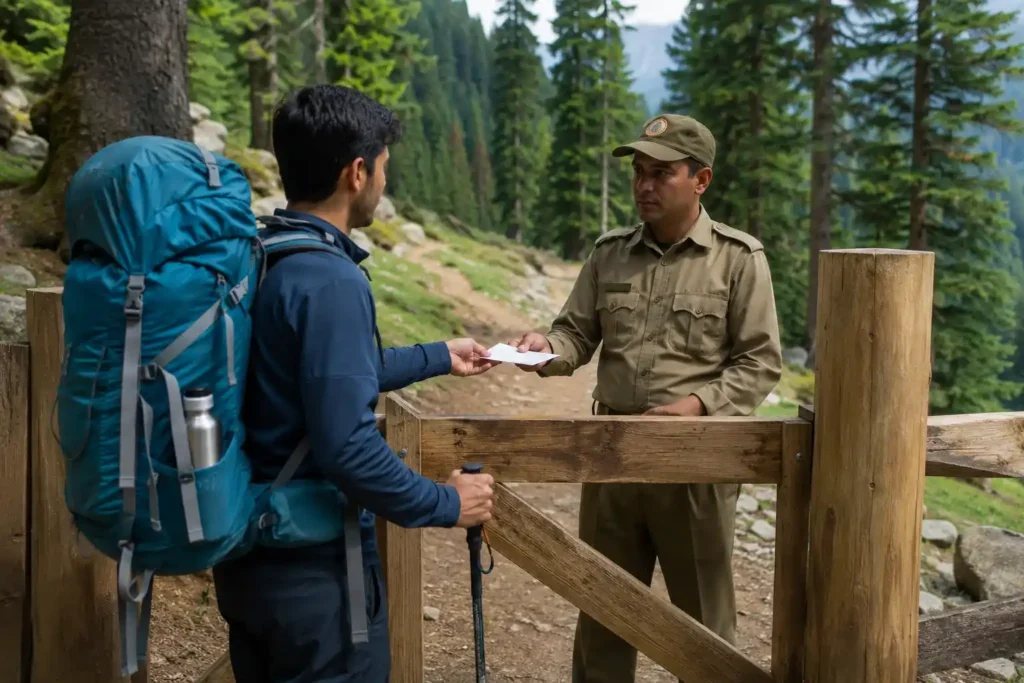
Type 1: J&K Trekker Registration
What it is: A registration system run by the J&K Tourism Department for multi-day trekkers entering Kashmir’s high-altitude trail network. Think of it as a trekker log, your name, ID, route, guide name and expected return date are recorded.
Who needs it: All trekkers — Indian and foreign going on multi-day routes starting from Sonamarg and Naranag.
Cost: Nominal. Approximately ₹50–₹100 per person. Included in all Travel My Kashmir packages.
Where to get it: At the J&K Tourism office in Sonamarg (for Vishansar and Great Lakes treks) or at the Naranag forest gate (for Gangabal Trek). Done at the start of Day 1 — not in advance.
Documents needed: Original government photo ID. Aadhaar card is fine for Indian nationals. Foreign nationals need passport with valid Indian visa.
Time required: 10–15 minutes at the office. No advance application. No waiting period.
Type 2: Forest / Wildlife Sanctuary Entry
What it is: Entry permits and registration for trekking routes that pass through Kashmir’s protected wildlife sanctuaries primarily the Overa-Aru Wildlife Sanctuary (511 sq km) covering the Pahalgam trekking belt.
Who needs it: All trekkers entering the Overa-Aru Wildlife Sanctuar which covers the Aru Valley trail to Lidderwat, the Kolahoi Glacier route and the Tarsar Marsar circuit.
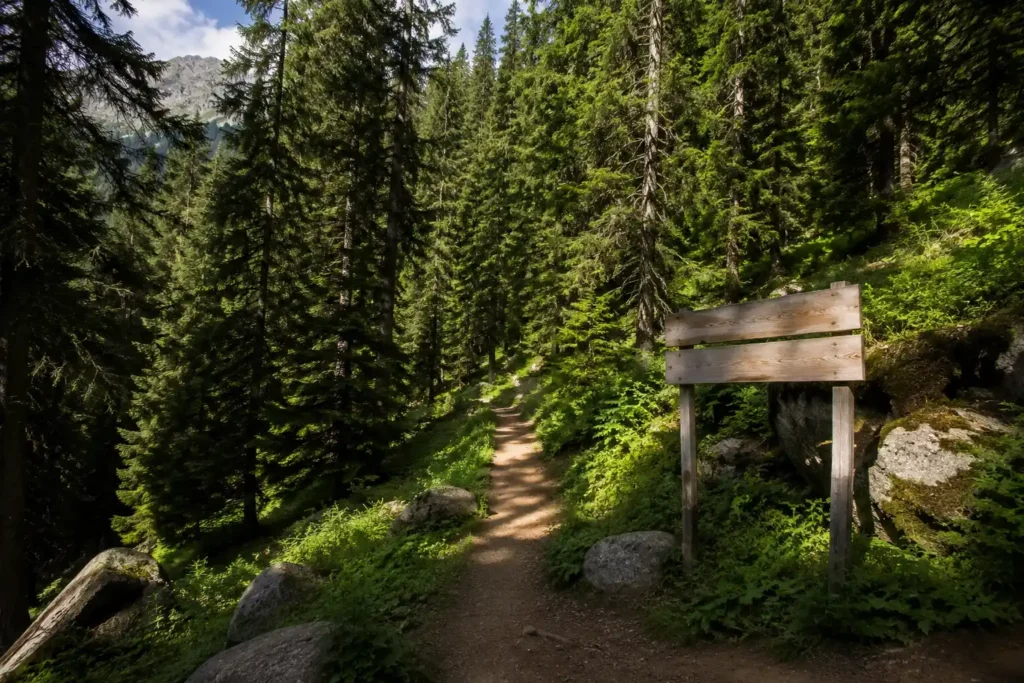
Cost: ₹20–₹50 per person for Indian nationals. Slightly higher for foreign nationals. Camping fees additional so confirm current rate at the checkpost as fees are revised periodically by the Wildlife Department.
Where to get it: At the forest checkpost at the boundary of the sanctuary, which you pass through on the trail out of Aru village toward Lidderwat. It is not an advance permit you pay at the gate on the day.
Documents needed: Photo ID. The guard at the checkpost records your name, ID number, group size, guide name, and expected return date.
Important note on camping: Overnight camping within the Overa-Aru Sanctuary which all multi-day treks from Aru require attracts a separate camping fee in addition to the entry fee. Travel My Kashmir handles all sanctuary fee payments for guided trek packages. Independent trekkers should carry sufficient cash there are no digital payment options at the checkpost.
Wildlife rules inside the sanctuary: The Overa-Aru Sanctuary is home to Himalayan brown bear, Asiatic black bear, Kashmir musk deer, common leopard, Himalayan ibex and over 117 bird species including the endangered Hangul (Kashmir stag). Guides on all Travel My Kashmir Aru-region treks carry standard wildlife awareness protocols food storage, noise management and trail behaviour guidelines. Follow the guide’s instructions without exception in the sanctuary.
Type 3: Restricted Area / DC Office Permit
What it is: A permit issued by the Deputy Commissioner’s office for trekking in areas designated as restricted due to proximity to the Line of Control. In Kashmir’s trekking context, this applies specifically and almost exclusively to Gurez Valley.
Who needs it: Foreign nationals visiting Gurez Valley. Indian nationals do not require this permit for Gurez as of 2026.
Cost: ₹100–₹200 per person (permit fee). Processing requires a trip to the Bandipora DC office or arrangement through a registered local operator.
Where to get it: Bandipora DC office. Travel My Kashmir handles this entirely for all Gurez Valley trek packages no separate trip to Bandipora required for our trekkers.
Time required: 2–3 working days for processing. Foreign nationals should initiate at least one week before planned departure. OCI cardholders follow the same process as foreign nationals.
Full details on Gurez permits in the dedicated section below.
Trek-by-Trek Permit Guide
Day Treks: Thajwas Glacier and Khilanmarg
Permit required: None for Indian or foreign nationals.
The Thajwas Glacier day trek from Sonamarg requires no permits. You walk from Sonamarg town toward the glacier ,the route is entirely within accessible tourist territory. There is an NMA (National Monuments Authority) or local authority entry fee collected at Sonamarg that covers the Thajwas glacier approach area approximately ₹50–₹100 per person, paid at a collection point near the start of the trail. This is not a trekking permit it’s an entry fee similar to monument entry fees elsewhere in India.
Khilanmarg from Gulmarg similarly requires no trekking permit. The Gondola Phase 1 ticket (approximately ₹750–₹900 per person) gets you up to Gulmarg meadow and from there the Khilanmarg walk is unrestricted.
Documents to carry: Standard photo ID. Always carry ID , army and police presence is normal in both Sonamarg and Gulmarg and random ID checks do occur.
Pahalgam Belt Treks: Tulian Lake, Nafran Valley
Permit required: Forest checkpost registration only. No advance permit.
The Tulian Lake Trek starts from Ganesh Bal (2 km from Pahalgam) and enters the forest zone almost immediately. There is a forest checkpost before the first significant climb. Registration here takes 5–10 minutes with these details name, ID, group size, guide name, destination, expected return. The fee is nominal.
Nafran Valley similarly has a forest entry point on the trail. Same process, same documents.
Important for Pahalgam-region treks: The Pahalgam local union taxi system means your vehicle to the trailhead must be arranged through the Pahalgam union taxi stand for certain trailhead access points. Private vehicles from Srinagar may be stopped at Pahalgam and asked to transfer to a local union vehicle for the final stretch to Ganesh Bal or Aru. Travel My Kashmir manages this transfer as part of our Pahalgam-region trek packages, it is not an additional cost to trekkers.
Documents to carry: Original photo ID plus two photocopies. The forest checkpost records photocopies in some cases. Having copies ready prevents delay.
Aru Valley, Kolahoi Glacier and Tarsar Marsar Treks
Permit required: Overa-Aru Wildlife Sanctuary entry and camping permits. Collected at checkpost so no advance application.
These three treks such as Aru Valley to Lidderwat, Kolahoi Glacier, and Tarsar Marsar all enter the Overa-Aru Wildlife Sanctuary within the first hour of leaving Aru village. The sanctuary checkpost is on the trail, not on the road you walk to it.
At the checkpost:
- Register your name, ID number, nationality, group size, guide name, destination, and expected return date
- Pay the entry fee (₹20–₹50 per person for Indians, higher for foreign nationals)
- Pay the overnight camping fee if applicable (per night per person — confirm current rate)
- Receive a stamped permit slip — keep this with you for the entire trek. You may be asked for it at army or forest patrol checkpoints further on the trail.
Wildlife and drone rules inside the sanctuary:
- Drones are strictly prohibited inside the Overa-Aru Wildlife Sanctuary without explicit written permission from the Chief Wildlife Warden, J&K. This is not a technicality — drone confiscation and fines have been imposed on trekkers violating this. If you want aerial footage of your trek, Aru Valley is not the place to fly without formal clearance.
- Photography of wildlife is unrestricted, but maintain distance from all animals. Brown bear sightings are possible above Lidderwat — follow guide instructions completely if encountered.
- Lighting campfires within the sanctuary is restricted. Your cook team will use gas stoves. Do not light independent fires.
Fishing within the sanctuary: The Lidder River and its tributaries within the Overa-Aru Sanctuary are premium trout waters. Fishing requires a separate J&K Fisheries Department permit in addition to the sanctuary entry permit. See the fishing permit section below.
Naranag Gangabal Trek
Permit required: J&K Tourism trekker registration at the Naranag forest gate or Wangath office. No advance application.
The Naranag Gangabal Trek starts from Naranag (Ganderbal district) and enters the Wangath forest zone. Registration at the gate is the same process as the Sonamarg trekker registration with name, ID, group size, guide, route, return date.
One additional consideration for Gangabal: The route crosses into the Harmukh-Gangabal area, which lies within the Sindh Valley Forest Division. Your guide will handle any secondary checkpoint interactions on the trail. Carry your forest gate registration slip throughout the trek.
Documents to carry: Photo ID plus two photocopies. Forest gate registration slip, keep this for the entire trek duration.
Vishansar Lake Trek and Kashmir Great Lakes Trek
Permit required: J&K Tourism trekker registration at Sonamarg Tourism Office. No advance application.
Both the Vishansar Lake Trek and the Kashmir Great Lakes Trek start from Shitkadi, 6 km beyond Sonamarg on the Srinagar-Leh highway. Before the trek begins, trekkers register at the Sonamarg Tourism Office or at the Shitkadi trailhead checkpost.
Registration contents: Name, nationality, ID number, group size, guide name, trek route, expected return date or endpoint (for the Great Lakes, the exit point is Naranag/Wangath in Ganderbal district).
Time required: 15–20 minutes at the office. Done on the morning of Day 1 before entering the trail. Travel My Kashmir handles this registration for all guided groups.
For the Great Lakes Trek specifically: Because the route exits at a different point from where it starts (Sonamarg in, Naranag out), carry your registration slip for the entire 7–8 day duration. The exit point at Naranag/Wangath has a forest office where departing trekkers de-register your guide manages this. If you exit without de-registering and your expected return date passes, the Tourism Department may initiate an alert. It doesn’t happen often but is avoidable by ensuring proper exit registration.
Army checkpoints on the Sonamarg–Nichnai–Vishansar trail: There are army or paramilitary posts on this trail, particularly near the Nichnai Pass area. These are standard. Your guide handles the checkpoint interaction. Carry your ID in a pocket accessible without unpacking your bag. Do not photograph military installations, personnel, or equipment at checkpoints this applies throughout Kashmir, not just at these specific points.
Gurez Valley Trek: The Most Involved Permit Process
Indian nationals: No permit required for Gurez Valley as of 2026. You will pass through multiple army and police checkpoints on the 140 km drive from Srinagar to Dawar just carry original photo ID at all times and have photocopies accessible. The checkpoints are standard procedure, not an indicator of restricted access. The process at each is vehicle stops, ID checked or noted, vehicle proceeds. Total time added across all checkpoints: 20–30 minutes on the drive.
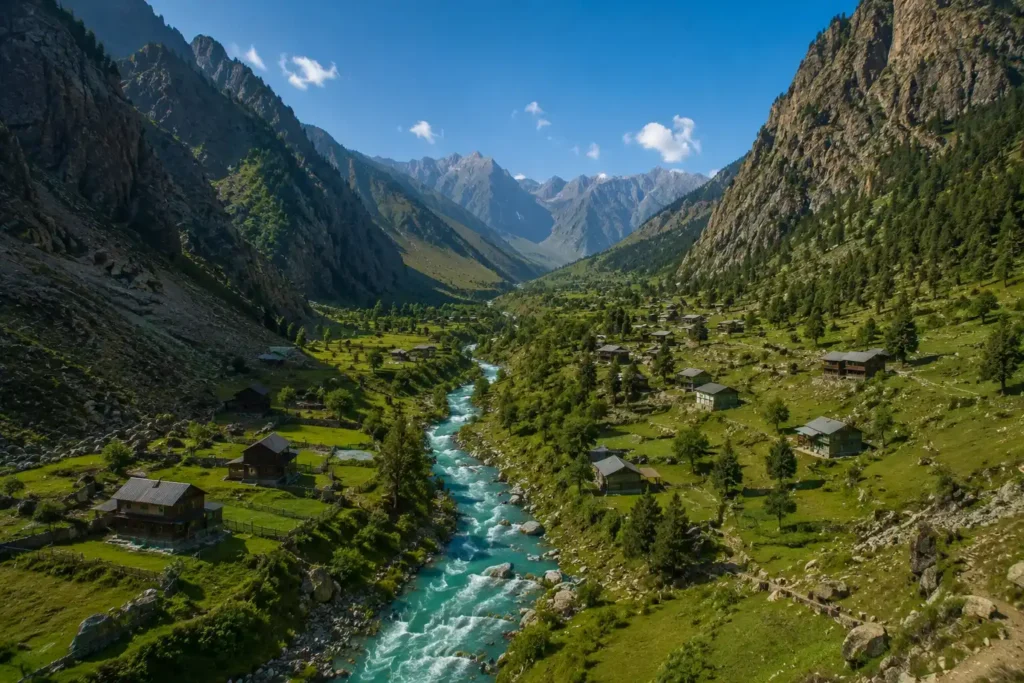
Foreign nationals: Gurez Valley officially opened to foreign tourists in 2025. Previously a zone closed to international visitors, it is now accessible but with a permit process that differs from what Indian nationals experience. check more details here Gurez valley permit for foreign nationals.
Foreign national permit process for Gurez Valley Trek:
The permit is issued by the Deputy Commissioner (DC) of Bandipora district. It is not an Inner Line Permit in the traditional sense it is a district-level access permission specific to the Gurez tehsil.
Required documents:
- Original passport with valid Indian tourist visa
- 3 photocopies of passport (photo page + visa page)
- 4 passport-size photographs
- Completed application form (available at the Bandipora DC office)
- A letter from your registered tour operator confirming trek itinerary and guide details — Travel My Kashmir provides this for all our Gurez bookings
Where to apply: Bandipora DC office. The office is located in Bandipora town, approximately 60 km north of Srinagar on the road to Gurez. Travel My Kashmir submits all foreign national permit applications on behalf of our trekkers so no separate visit to Bandipora is required when booking through us.
Processing time: 2–3 working days in normal conditions. Access is not guaranteed as these permits may get denied, so it is crucial to have a few buffer days if planning to visit Gurez. Build flexibility into your itinerary.
OCI cardholders: OCI cardholders are allowed with relatively fewer restrictions provided they inform the DC office. The process is similar to foreign nationals but approval is generally more straightforward.
Pakistani, Chinese and Afghan nationals: Entry to Gurez Valley and border-adjacent areas is subject to additional clearance requirements from the Ministry of Home Affairs, New Delhi. This process takes significantly longer so plan at minimum 4 weeks in advance and consult Travel My Kashmir directly for current requirements.
At army checkpoints in Gurez: You will pass through multiple army and police checkpoints. For foreign nationals, this means presenting the DC permit alongside passport and visa at every checkpoint. Carry printed copies as digital copies on phone screens are not accepted. Your guide holds the group permit copies and leads checkpoint interactions.
Tulail Valley (beyond Gurez): Tulail Valley lies beyond Gurez, parallel to the LoC and is a highly restricted area requiring special permissions due to its close proximity to the border. Going beyond Gurez requires a pass from the local police station and then the army stops you at the main entry gate and seeks permission from their higher-ups. The Gurez Valley Trek operated by Travel My Kashmir does not go into Tulail , the Patalwansar Lakes route stays within the Gurez tehsil. Do not attempt to enter Tulail without explicit separate clearance.
Full route details for the trek itself are on the Gurez Valley Trek page.
Fishing Permits: A Separate System Entirely
If trekking and fishing are part of the same trip particularly on the Vishansar Lake, Krishansar Lake or Lidder River routes, fishing permits operate under a completely different system from trekking permits. For more details check our fishing in Kashmir guide
Issuing authority: J&K Directorate of Fisheries
What requires a permit: All trout fishing in J&K waters. A fishing license is mandatory for all anglers.
How permits work:
- Licenses are usually valid for one day and cover a specific fishing beat of about 2 km.
- Separate permits are required for each water body as the Lidder River permit does not cover Vishansar Lake.
- Only artificial flies may be used for trout fishing; natural baits are strictly prohibited.
- Each angler is allowed a daily bag limit of six fish.
- Season: April to October, with the Directorate adjusting dates based on conditions. Popular beats include the Lidder River (Pahalgam), Sind River (Sonamarg) and alpine lakes like Vishansar Lake and Gangabal Lake.
Where to get them:
- Pahalgam Fisheries office for Lidder River beats and Pahalgam-region lakes
- Sonamarg Fisheries office for Sind River and Vishansar/Krishansar lakes
- Permits can be applied for online at the Directorate of Fisheries website confirm the current website URL with Travel My Kashmir as portal addresses have changed
Plan in advance: Fishing permits on popular beats (Lidder River near Pahalgam, Vishansar Lake in peak season) sell out. Arrange at least 2–3 days before your planned fishing date and earlier in July and August.
Travel My Kashmir can arrange fishing permit logistics as part of combined trek-and-fishing itineraries. Contact us to discuss.
Drone Rules for Kashmir Trekkers
This section exists because drone questions come up frequently and the rules are stricter than most trekkers expect.
The blanket rule: Drones are treated as aircraft under India’s drone framework. Recreational or commercial drone flights are not permitted inside Protected Areas which includes the Overa-Aru Wildlife Sanctuary covering the entire Pahalgam trekking belt without explicit written permission from the Chief Wildlife Warden.
The border zone rule: No drones within the 25 km belt along India’s international borders (includes LoC). The Gurez Valley Trek operates within this belt. Flying a drone in Gurez without specific military and civil aviation clearance is a serious legal violation, not a technicality.
What this means in practice:
- Do not bring a drone to any Pahalgam-region trek (Aru, Kolahoi, Tarsar Marsar, Tulian Lake, Nafran Valley)
- Do not bring a drone on the Gurez Valley Trek
- On Sonamarg-based routes (Vishansar, Great Lakes), drone rules are less absolute but army checkpoint presence on the trail means any drone seen flying near military positions will be treated as a security issue
- If you have a professional photography requirement that needs aerial footage, contact Travel My Kashmir well in advance proper clearance applications take weeks and are not guaranteed
What Happens at Army Checkpoints: A Practical Guide
Army and paramilitary checkpoints are a normal part of trekking in Kashmir. They exist on approach roads (particularly the Srinagar–Sonamarg highway and the Bandipora–Gurez road), at valley entry points and occasionally on the trail itself above certain elevations.
What to expect: The vehicle or trekking group stops at the checkpoint. A soldier approaches, sometimes they check ID documents, sometimes they note the vehicle registration, sometimes they wave you through. The interaction is usually brief and professional. The length varies by checkpoint sensitivity and current security conditions.
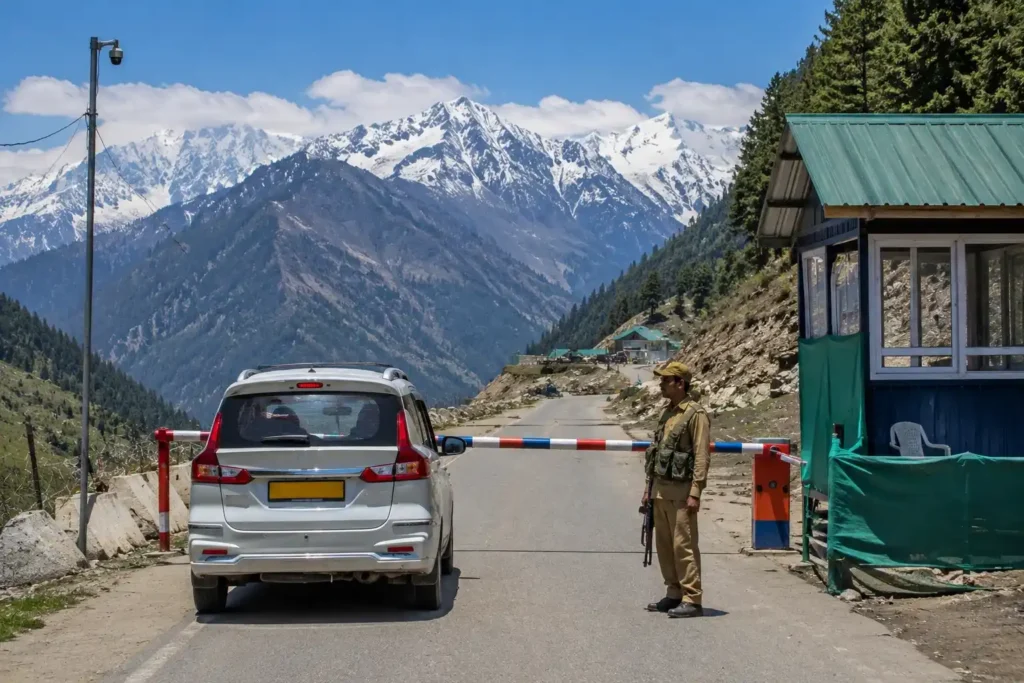
What to carry and how to carry it:
- Original government photo ID in a pocket you can access without removing your backpack
- Photocopies of ID separately stored, if your originals are in your sleeping bag at the bottom of your pack, the checkpoint interaction becomes awkward
- For Gurez: printed permit copies, not phone screen. Always printed.
- For foreign nationals anywhere in Kashmir: passport and valid Indian visa together
What not to do:
- Do not photograph checkpoints, military personnel, vehicles or installations. This is consistent across all of Kashmir, not specific to restricted areas. Cameras pointed at security infrastructure are taken seriously and confiscation or questioning follows.
- Do not be impatient or argumentative. Checkpoints operate on their own timeline. Build them into your driving time estimate.
- Do not misrepresent your route, group size or purpose. The permit system exists and guides know to be accurate.
Your guide leads checkpoint interactions: On all Travel My Kashmir guided treks, your guide manages checkpoint procedures presenting documentation, answering questions, coordinating the group. This is one of the genuine practical advantages of trekking with a local guide who knows the checkpoints and the personnel on specific routes.
FRRO registration for foreign nationals
Foreign nationals staying in India for more than 14 days on certain visa categories, or visiting sensitive areas, may need to register with the Foreigners Regional Registration Office (FRRO). Most standard tourist e-Visa holders do not need separate FRRO registration if their hotel submits the C-form (which all registered hotels do automatically). If you’re unsure whether your visa category requires FRRO registration, check with your tour operator before arrival.
OCI cardholders: Generally treated as foreign nationals for restricted area access purposes. For Gurez, the DC permit process applies. For standard Kashmir trekking routes, OCI holders have the same access as Indian nationals.
How Travel My Kashmir Handles Permits
Every Travel My Kashmir guided trek package includes complete permit management. This means:
- J&K Tourism trekker registration on the morning of Day 1
- Forest and sanctuary entry fees paid at checkposts
- Permit documentation carried by your guide throughout the trek
- Checkpoint interactions managed by guide
- For Gurez Valley packages: full DC permit processing for foreign nationals, advance submission, printed copies for all group members
There is no separate permit charge on top of the package price for standard routes. For Gurez Valley foreign national permits, the DC processing fee (₹100–₹200 per person) is included. Fishing permits are arranged separately on request.
One thing we cannot do: Guarantee permit approval for foreign nationals applying for the Gurez DC permit. Approval is at the discretion of the Bandipora DC office and in some cases, security conditions affect decisions. We advise all Gurez-bound foreign national clients to build 1–2 buffer days into their itinerary and have an alternative trek option available if the permit is delayed or denied.
For any permit question specific to your nationality, route or travel dates, call or WhatsApp Travel My Kashmir at +91 979-646-6052 or contact us online.
Frequently Asked Questions
Q: Do Indian nationals need any permit for Kashmir trekking?
A: For most routes the answer is no. Day treks (Thajwas, Khilanmarg) need no permit at all. Multi-day routes through the Overa-Aru Wildlife Sanctuary (Aru, Kolahoi, Tarsar Marsar) require a forest entry registration at the checkpost, paid on the day. Sonamarg-based routes (Vishansar, Great Lakes) require J&K Tourism trekker registration on Day 1 morning. Gurez Valley needs no permit for Indian nationals just a valid photo ID at army checkpoints.
Q: Do foreign nationals need an Inner Line Permit for Kashmir trekking?
A: For standard Kashmir trekking routes such as Vishansar, Great Lakes, Tarsar Marsar, Tulian Lake, Kolahoi no Inner Line Permit is required. Your Indian tourist visa is sufficient. The Gurez Valley Trek requires a DC Bandipora permit for foreign nationals (different from an ILP processed at district level, not state level). See the Gurez section above for the full process.
Q: Can I get permits on the spot or do I need to apply in advance?
A: For all standard Kashmir trekking routes, permits are collected on the day at the checkpost or tourism office with no advance application required. The exception is the Gurez Valley DC permit for foreign nationals, which takes 2–3 working days to process and should be initiated at least one week before departure. Fishing permits should be arranged 2–3 days in advance.
Q: What ID do I need to carry on Kashmir treks?
A: Indian nationals: Aadhaar card, voter ID, driving licence, or passport. Carry the original plus two photocopies stored separately. Aadhaar is the most universally accepted at checkposts and registration offices. Foreign nationals: Passport with valid Indian visa. Carry the original plus two copies of the photo page and visa page. If you have a Gurez DC permit, carry printed copies as digital is not accepted.
Q: Is a guide mandatory for Kashmir trekking from a permit perspective?
A: No trek in Kashmir has a legal requirement for a certified guide as a permit condition the permits don’t specify this. However, guide registration is recorded at forest checkposts (your guide’s name goes in the register), which means trekking without a guide on sanctuary routes creates a registration gap. More practically, army checkpoints on remote routes are navigated significantly more smoothly with a local guide who knows the personnel and the procedure. For treks above 3,000 m, a guide is strongly recommended for safety regardless of permit requirements.
Q: Can I fly a drone on Kashmir trekking routes?
A: Not without specific written clearance. Drones are prohibited inside wildlife sanctuaries (Overa-Aru covers all Pahalgam routes) and within 25 km of the LoC (covers Gurez). On other routes, army presence near the trail makes drone operation a security-sensitive activity. Get explicit written permission before bringing a drone on any Kashmir trek or leave it at home.
Q: What happens if I’m turned back at a checkpoint?
A: If your documentation is incomplete with missing permit for foreign nationals at Gurez, missing ID at a forest checkpost the checkpoint will turn you back to obtain the correct documents. This doesn’t result in fines in most cases, but it does mean losing a day of your trek. The way to prevent it: have all documents prepared before Day 1, carry photocopies separately from originals and book through a local operator who manages the permit process.
Q: Are there any treks in Kashmir that are completely off-limits?
A: Tulail Valley beyond Gurez is restricted and requires police station and army clearance beyond what the standard Gurez permit covers. Some high-altitude passes near the LoC in the northern sections of the Great Lakes circuit are sensitive , your guide will not take you into genuinely restricted territory. Outside these specific zones, Kashmir’s recreational trekking routes are accessible with the permits described on this page.
Have a permit question specific to your nationality, route or travel dates? Call or WhatsApp Travel My Kashmir at +91 979-646-6052. We handle permits for every trek we operate so you don’t need to figure out the checkpost system on your own.
Planning your trek? See the Kashmir trekking cost guide for pricing, the best time for trekking in Kashmir for timing, the Kashmir trekking packing list for gear and the complete Kashmir trekking guide for all routes.