
If you are already travelling all the way to Katra for the Mata Vaishno Devi yatra, you are remarkably close to one of the most beautiful regions in India. With the Udhampur–Srinagar–Baramulla rail link now operational, the Jammu corridor and the Kashmir Valley sit on the same line which means you can complete your darshan and continue straight into Srinagar, Gulmarg and Pahalgam without backtracking. This guide shows you how the two trips fit together, with travel links, a sample itinerary and practical planning notes.
If your first priority is the pilgrimage itself, start with our Vaishno Devi helicopter booking guide to lock in your darshan, then use the itinerary below for the Kashmir leg.

Why the two trips pair so well
Katra (station code SVDK) and Srinagar are connected by the same railway corridor that carries the new Vande Bharat services. Pilgrims arriving from Delhi can reach Katra by the Delhi–Srinagar Vande Bharat train, which stops at Shri Mata Vaishno Devi Katra and then continue onward to the valley. The result is a natural two-part trip: devotion first, then the mountains without the cost and fatigue of returning home in between.
Getting from Katra to Srinagar
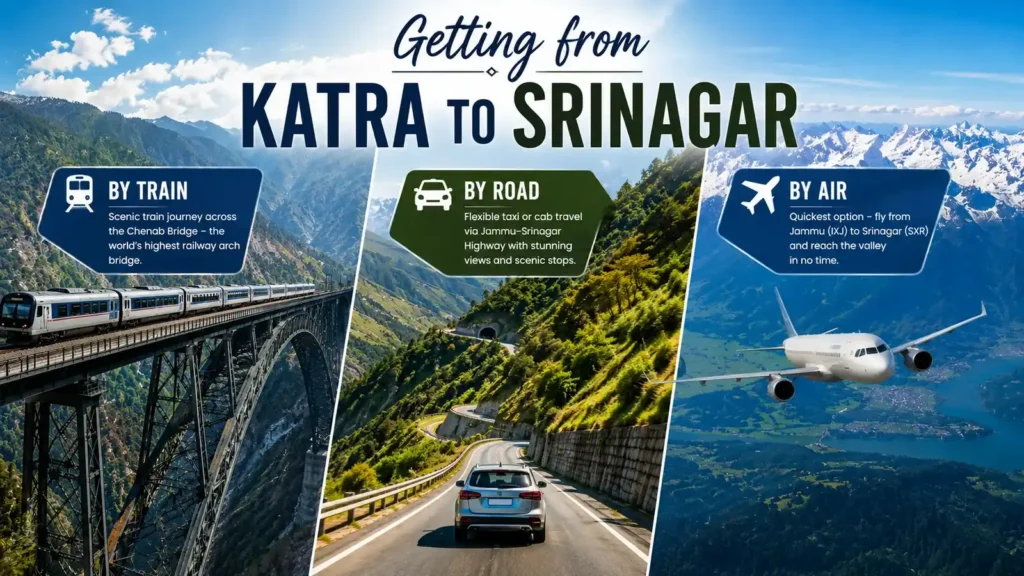
You have three realistic ways to make the Katra → Srinagar leg:
- By train. The fastest and most scenic option, crossing the world’s highest railway arch bridge over the Chenab. See our Katra to Srinagar train guide for routing and fares and the Srinagar Vande Bharat page for the valley side service.
- By road/taxi. A private cab along the Jammu–Srinagar National Highway gives you flexibility to stop at some beautiful viewpoints. Travel My Kashmir can arrange this transfer as part of a package.
- By air. Fly Jammu (IXJ) to Srinagar (SXR) if you are short on time this is the quickest option, but you miss the dramatic overland scenery.
For driving distances and road conditions across the corridor, our Jammu to Kashmir distance guide has the full breakdown.
Sample 8-day combined itinerary
This is a comfortable pace that gives the yatra its due and still covers the valley’s highlights. Adjust nights up or down to suit your time.
| Day | Base | Plan |
|---|---|---|
| Day 1 | Katra | Arrive, complete Yatra registration and rest |
| Day 2 | Katra / Bhawan | Vaishno Devi darshan via helicopter or trek; overnight at Bhawan or return to Katra |
| Day 3 | Katra → Srinagar | Travel to Srinagar by train, taxi, or flight; enjoy evening shikara ride on Dal Lake |
| Day 4 | Srinagar | Visit Mughal Gardens, explore Old City, houseboat stay |
| Day 5 | Pahalgam | Drive to Pahalgam; visit Betaab Valley and Aru Valley |
| Day 6 | Gulmarg | Drive to Gulmarg; experience Gondola cable car ride |
| Day 7 | Sonamarg | Day trip or transfer to Sonamarg; visit Thajiwas Glacier |
| Day 8 | Srinagar → Home | Departure from Srinagar |
You can compress this to 6 days by dropping Sonamarg or extend it to include Doodhpathri, Yusmarg or Gurez for a quieter, offbeat finish.
What to pre-book versus arrange on the ground
Some things genuinely need advance booking while some others are easy to organise once you arrive.
Book ahead:
- Your helicopter slot and Yatra Parchi for Vaishno Devi (these sell out fast in peak season)
- Train tickets for the Katra–Srinagar leg, especially the Vande Bharat
- The Gulmarg Gondola in high season — see our Gulmarg cable car booking page
A houseboat or hotel for your first Srinagar night

Arrange on arrival or via a package:
Day-to-day taxis within the valley, our Srinagar taxi and Kashmir cab service covers point-to-point and full-itinerary cars
Shikara rides, local sightseeing and the Pahalgam union taxi sightseeing circuits
If you would rather not stitch all of this together yourself, Travel My Kashmir’s Kashmir tour packages bundle the valley portion including transfers, stays and sightseeing so you only have to handle the pilgrimage leg separately.
Budgeting the combined trip
Costs vary widely with season and comfort level, but as a rough frame for the Kashmir portion, valley transfers by private taxi, a mix of hotel and houseboat nights, the Gondola and a shikara ride are the main line items. The pilgrimage leg adds your helicopter fare (₹2,320 one-way / ₹4,640 return per person in 2026, if you fly) plus accommodation in Katra. Peak months May–June and the Navratri windows push both demand and price up, so booking early protects your budget as well as your dates.
Best time to do both
The sweet spot is April to June and September to October, when Katra is comfortable and the Kashmir Valley is at its most pleasant with tulips and spring greenery early in the season, crisp clear air and autumn colour later. December–February turns the valley into a snow destination (Gulmarg for skiing), but mountain passes and weather need more planning and helicopter flights at Vaishno Devi can be disrupted by fog.
Frequently asked questions
Q: Can I visit Kashmir right after Vaishno Devi?
A: Yes, Katra and Srinagar are on the same rail corridor. You can finish your darshan and continue to Srinagar by train, taxi or a short flight, with no need to return home in between.
Q: How do I get from Katra to Srinagar?
A: By train (fastest and most scenic, crossing the Chenab bridge), by private taxi along the highway or by flying Jammu to Srinagar. See our Katra to Srinagar train guide for details.
Q: How many days do I need for both?
A: A comfortable combined trip is 7–9 days: roughly two days for the yatra and five to seven for the valley. It can be trimmed to six.
Q: Should I book the helicopter and Gondola in advance?
A: Yes. Both are weather dependent and limited and both sell out in peak season. Reserve the Vaishno Devi helicopter and the Gulmarg Gondola as early as you can.
Q: Can Travel My Kashmir arrange the whole valley portion?
A: Yes, taxis, stays, sightseeing and full tour packages for the Kashmir leg, so you only handle the pilgrimage booking yoursel
Ready to plan? Lock in your darshan via the Vaishno Devi helicopter booking guide, then talk to Travel My Kashmir Tour and Travel Agency about the onward Kashmir leg with options of trains, taxis and tour packages.