
The journey from Katra to the Vaishno Devi Bhawan is about 13 km one-way and most pilgrims complete it in 5 to 8 hours on foot. But “13 km” hides a lot of useful detail, there are three different tracks to choose from, several shrines along the way and a mix of ponies, battery cars and a ropeway that can make the climb far easier. This guide breaks down the full route, the distance between each waypoint, realistic timings and the registration you must complete before you start.
If walking the whole way isn’t right for your group, the Vaishno Devi helicopter reaches the Sanjichhat helipad in about 8 minutes, leaving just a 2.5 km walk to the Bhawan.
Check our detailed Vaishno Devi Yatra guide for darshan timings, route details and travel tips.
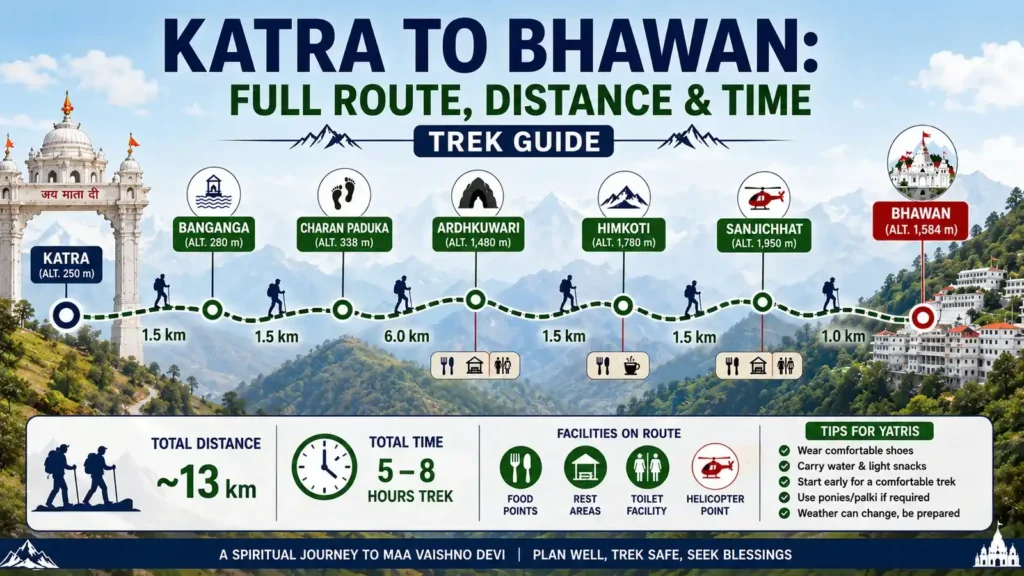
The classic route at a glance
The traditional walking route runs:
Katra (Darshani Deori) → Banganga → Charan Paduka → Ardhkuwari → Himkoti → Sanjichhat → Bhawan
| Stretch | Approx. Distance | Notes |
|---|---|---|
| Katra Bus Stand → Banganga | ~2 km | Walk, auto, or taxi; 15–20 min. Trek and registration start here |
| Banganga → Charan Paduka | ~1.5 km | First shrine; associated with the Goddess’s footprints |
| Charan Paduka → Ardhkuwari | ~4.5 km | Ardhkuwari is ~6 km from Banganga; includes Garbh Joon cave |
| Ardhkuwari → Himkoti | ~2.5 km | Scenic stretch with food stalls and rest points |
| Himkoti → Sanjichhat → Bhawan | ~4 km | Sanjichhat is helicopter drop point; ~2.5 km from there to Bhawan |
| Total (Katra → Bhawan) | ~13 km | Takes around 5–8 hours on foot depending on pace |
Distances are approximate and track conditions can change always check current signage and counters at Katra and Banganga.
The three tracks and how to choose
This is where most online guides cause confusion, because the route names overlap. Here is the simple version.
1. Old Track (Banganga route). The classic, historic path most pilgrims take, via Banganga, Charan Paduka and Ardhkuwari. Ponies, palki and pithoo carriers are available here and it has the densest cluster of shops, langars and services. Choose this if you want the traditional experience and easy access to hired transport.
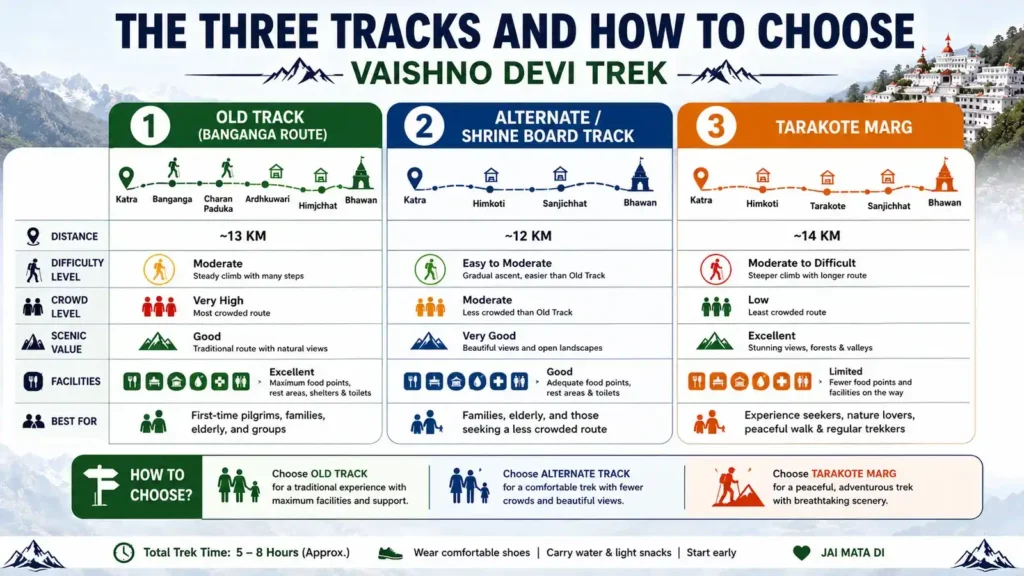
2. Alternate / Shrine Board track. A newer stretch that branches below Ardhkuwari wider, with a gentler gradient designed to ease the climb. Ponies are not permitted, but battery cars run on designated segments. Choose this if you want a smoother walking surface after Ardhkuwari.
3. Tarakote Marg. Inaugurated in 2018, this is the “new route” you will see searched online. It is roughly 2 km longer but has a gentle slope, cleaner air, no ponies or palki and scenic viewpoints, with battery cars on permitted stretches. It rejoins the old route higher up, so you can switch. Choose this if you are walking with senior citizens who want an easier gradient and less congestion though note it bypasses some of the traditional shrine stops, which is why many devotees still prefer the old track.
Battery car, ropeway and other ways to ease the climb
You are never locked into walking every metre:
Ponies, palki and pithoo — available on the old track. Hire only through authorised counters and check the official rate card, don’t pay above the displayed rate.
Battery car — runs on permitted stretches near the top (around Ardhkuwari/Himkoti to Bhawan), with limited seats and priority for seniors and differently abled pilgrims. Pre book through official counters where possible.
Ropeway (Bhawan → Bhairon Ghati) — a short scenic ride of a few minutes (indicatively around ₹100 per person) that replaces a steep climb up to the Bhairon Mandir. The yatra is traditionally considered complete only after Bhairon darshan, so this ropeway is a popular, effortless finish.
Registration: the RFID card you can't skip
Yatra registration is mandatory. Every pilgrim needs an RFID Yatra Access Card, issued free of cost. You can get it after booking your Yatra Parchi online on the official Shrine Board portal or collect it at counters in Katra (railway station, bus stand and near the airport) and at the Banganga/Tarakote entry points.
Two rules trip people up:
- You must cross the first check post within a few hours of the card being issued or it can be cancelled and you will need a fresh one.
- The RFID card must be returned at the designated exit points (Banganga, Tarakote or the Serli helipad) after your yatra.
Registered pilgrims are also covered by the Shrine Board’s accident insurance, so registering protects you in more ways than one.
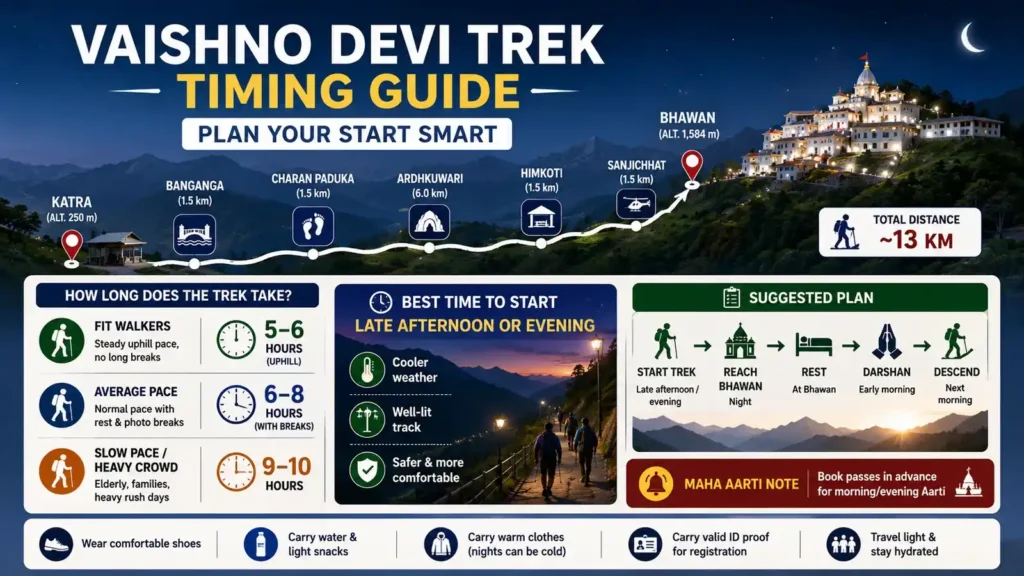
Realistic timing — plan your start
- Fit walkers: 5–6 hours up.
- Average pace: 6–8 hours up, with breaks.
- Slow pace or heavy crowd: can stretch to 9–10 hours.
A common, comfortable plan is to start the climb in the late afternoon or evening (the track is well lit and cooler at night), reach the Bhawan, rest, take darshan and descend the next morning. If you are aiming for the morning or evening Maha Aarti at the Bhawan, enquire about passes in advance.
What to carry and seasonal tips
The track has water points, langars (including the government Bhojanalaya at Ardhkuwari), medical aid centres and shelters roughly every 500 metres, so you can travel light. Bring:
- Trekking shoes with good grip and an optional walking stick
- Light layers plus a windbreaker, in winter add a beanie and gloves, as it gets cold near Bhairon Ghati
- A refillable water bottle, basic medicines, valid ID and a little cash plus UPI
- A compact poncho in monsoon (July–August), when landslide advisories should be watched
Leather items and electronics are not allowed inside the holy cave use the cloakrooms and lockers at Katra or the Bhawan.
Best seasons: spring (March–April) and autumn (September–November) are the most pleasant. Summer (May–June) is warm in Katra but comfortable higher up. Avoid the monsoon if you can. Winter is cold with possible snow near Bhairon, but offers clear views and thinner crowds.
Frequently asked questions
Q: How long is the Vaishno Devi trek from Katra to Bhawan?
A: About 13 km one-way, taking 5–8 hours on foot depending on your fitness and the crowd.
Q: What is the Ardhkuwari to Bhawan distance?
A: Roughly 6 km, including the Himkoti and Sanjichhat stretch.
Q: Which route is easiest for senior citizens?
A: The Tarakote Marg and the alternate Shrine Board track have gentler gradients. Combining a battery car for the upper section or taking the helicopter, eases it further.
Q: Is registration really required to walk?
A: Yes. You cannot pass the Banganga check post without a valid Yatra Parchi and RFID card. Both are free.
Q: Can I avoid the final climb to Bhairon Temple?
A: Yes, the Bhawan–Bhairon Ghati ropeway covers that steep stretch in a few minutes.
Q: How far do I walk if I take the helicopter instead?
A: Only about 2.5 km, from the Sanjichhat helipad down to the Bhawan.
Not sure whether to walk or fly? Compare both honestly in our helicopter vs trek guide. And if you are heading into the Kashmir Valley after darshan, see our Vaishno Devi + Kashmir itinerary.