
Places to Visit in Srinagar: Complete Sightseeing Guide
Srinagar is more than a stopover on the way to Gulmarg or Pahalgam. It deserves at least two to three full days if you want to explore its lakes, Mughal gardens, shrines, old city and mountain views without rushing. The summer capital of Jammu & Kashmir brings together the historic Old City, beautiful Mughal gardens, important religious sites and the famous Dal Lake all set against the Zabarwan hills.
As a Srinagar based travel company we have organized this guide around the way we actually plan sightseeing for our guests. Dal Lake and nearby attractions first, followed by the Mughal gardens, hilltop viewpoints and the Old City. This makes it easier to turn the list into a practical one- or two-day Srinagar sightseeing circuit by cab.
Also explore the top places to visit in Kashmir in 2026
Quick Overview: Best Places to Visit in Srinagar
| Place | Type | Best Time of Day / Season |
|---|---|---|
| Dal Lake & Shikara Ride | Lake | Early morning or sunset |
| Nishat Bagh | Mughal Garden | Morning |
| Shalimar Bagh | Mughal Garden | Morning or afternoon |
| Chashme Shahi | Mughal Garden | Morning |
| Pari Mahal | Historic Monument | Late afternoon or sunset |
| Shankaracharya Temple | Hilltop Temple | Early morning |
| Hazratbal Shrine | Religious Site | Morning |
| Jamia Masjid | Historic Mosque | Late morning |
| Hari Parbat Fort | Fort & Hill | Morning; avoid midday heat |
| Nigeen Lake | Lake | Evening for a quieter experience |
| Indira Gandhi Memorial Tulip Garden | Seasonal Garden | Late March to April |
| Dachigam National Park | Wildlife Sanctuary | Morning; permit required |
| Zero Bridge | Local Landmark | Sunset |
| Badam Wari Park | Early spring almond blossoms, quiet pathways | Morning / Spring |
| Polo View Market & Lal Chowk | Pedestrian shopping, Kashmiri handicrafts, local street food | Late Afternoon / Evening |
The Lakes
Dal Lake
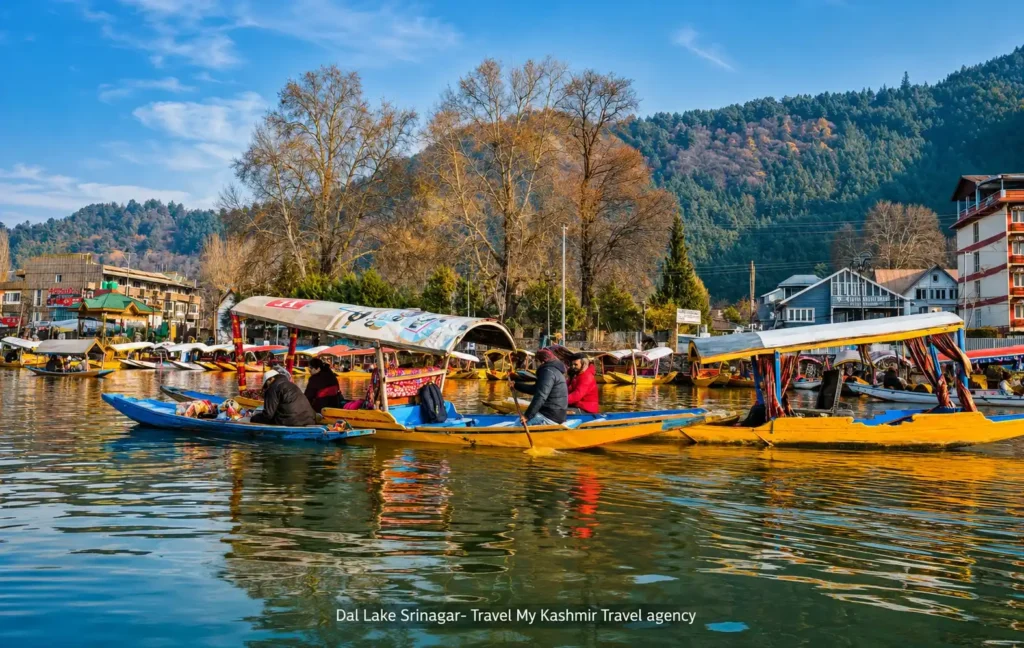
Dal Lake is the most famous attraction in Srinagar and a central part of the city’s tourism. Take a Shikara ride, stay on a traditional houseboat, see the floating gardens or visit the early morning floating vegetable market. If you are visiting Srinagar for the first time, Dal Lake should be high on your list. You can book a Shikara ride online or book a houseboat stay.
A typical Shikara ride on Dal Lake lasts around 1 to 1.5 hours. Depending on the route and season you may pass through the floating market, lotus covered areas near Kabutar Khana and houseboat colonies.
Explore more about Dal Lake here
- Location: Central Srinagar along Boulevard Road.
- Timing: Open 24/7. Shikaras operate from dawn until around 9:00 PM.
- Shikara Costs: Fixed government rates apply (approx. ₹770 per hour per boat), but prices vary by season and duration. Agree on the fare and duration before boarding.
- Who it is for: Suitable for all travelers—families, couples, children, and elderly visitors.
Nigeen Lake
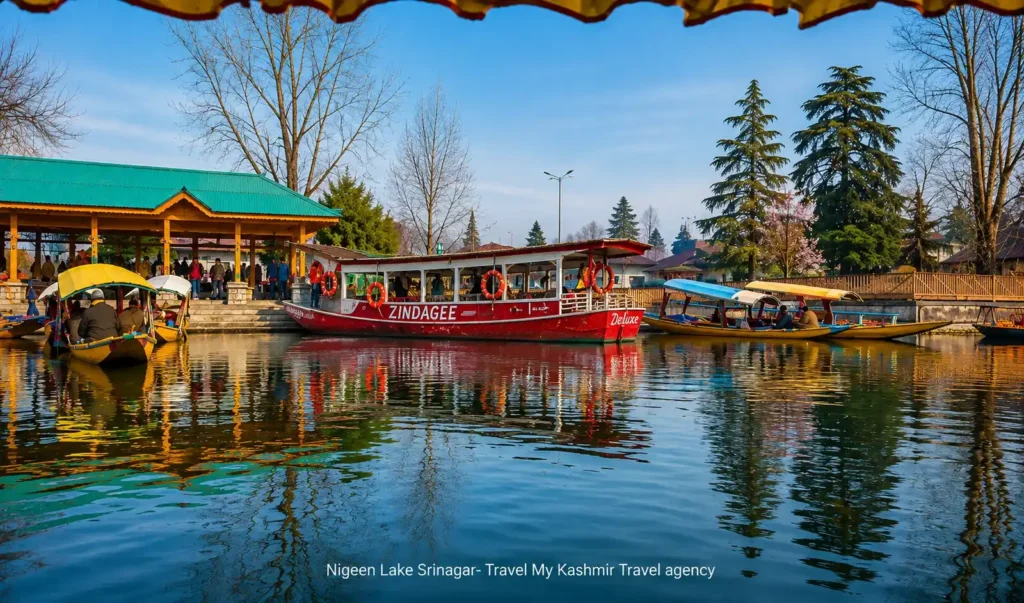
Nigeen Lake is a quieter alternative to Dal Lake connected to it by a narrow channel. It has fewer Shikaras, a more peaceful setting and several houseboats. It is a good choice if you want a quieter lake experience in Srinagar especially around sunset. See our Nigeen Lake Shikara guide.
If Dal Lake sounds too commercial for your taste, or you want a peaceful evening rather than a sightseeing checklist staying a night on a Nigeen houseboat instead of a Dal Lake one is worth considering.
- Location: Rainawari/Hazratbal side, roughly 8 km from Dalgate.
- Timing: Open daily.
- Who it is for: Best for couples, solo travelers and anyone seeking a quiet retreat.
The Mughal Gardens (Nishat, Shalimar & Cheshma Shahi)
The Mughal gardens in Srinagar are concentrated along the eastern side of Dal Lake making them easy to combine in one sightseeing route. Shalimar Bagh, Nishat Bagh and Chashma Shahi are the main Mughal gardens while Pari Mahal sits above Chashma Shahi and is often included in the same circuit. The Tulip Garden is nearby and is a seasonal addition in spring. The entry fee to Mughal gardens is ₹20–₹30 per adult for each garden.
Shalimar Bagh
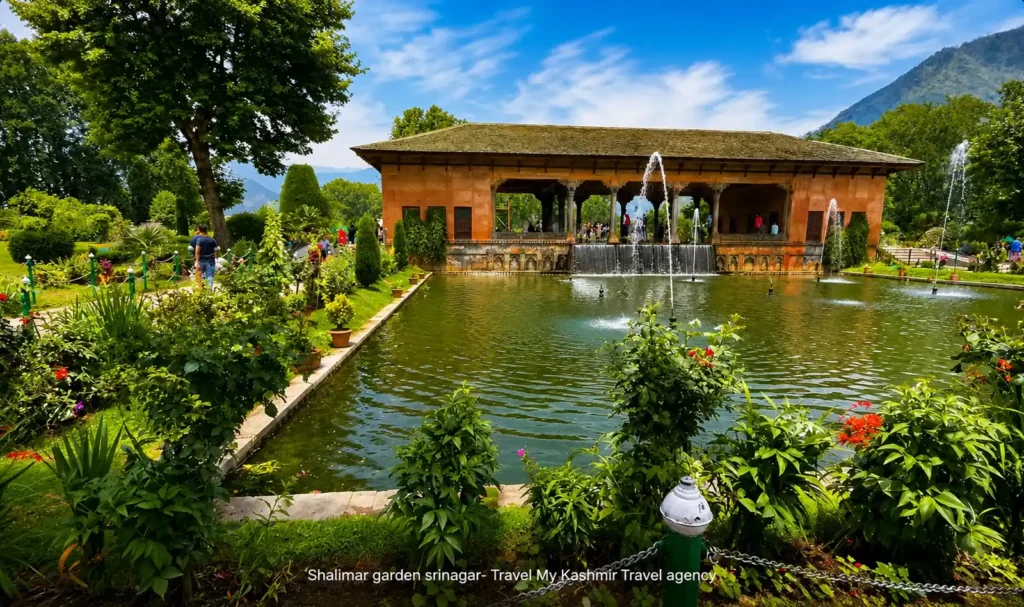
Shalimar Bagh is the largest of Srinagar’s three main Mughal gardens built by Emperor Jahangir in 1619 for his wife Nur Jahan. Its four terraces, old Chinar trees, water channels and black-pillared Baradari make it one of the most impressive historic gardens in Srinagar.
It features a black marble pavilion (Diwan-e-Khas) surrounded by water fountains. It is slightly further from the lake than Nishat.
Nishat Bagh
Nishat Bagh, known as the “Garden of Joy,” this Mughal garden has twelve terraces rising towards the Zabarwan representing the zodiac signs, cascading down toward Dal Lake. Its elevated position gives you excellent views across Dal Lake thus making it particularly good for photography.
Learn more about Nishat Bagh and its beautiful Mughal gardens in our detailed guide.
Chashma Shahi
Chashma Shahi is the smallest of the three main Mughal gardens built around a natural spring. It is compact enough to explore quickly and can be combined easily with Pari Mahal on the same sightseeing trip.
Built by Ali Mardan Khan in 1632 around a natural mountain spring. The spring water is cold, mineral-rich and historically favored by Mughal royalty.
Pari Mahal (Palace of Fairies)
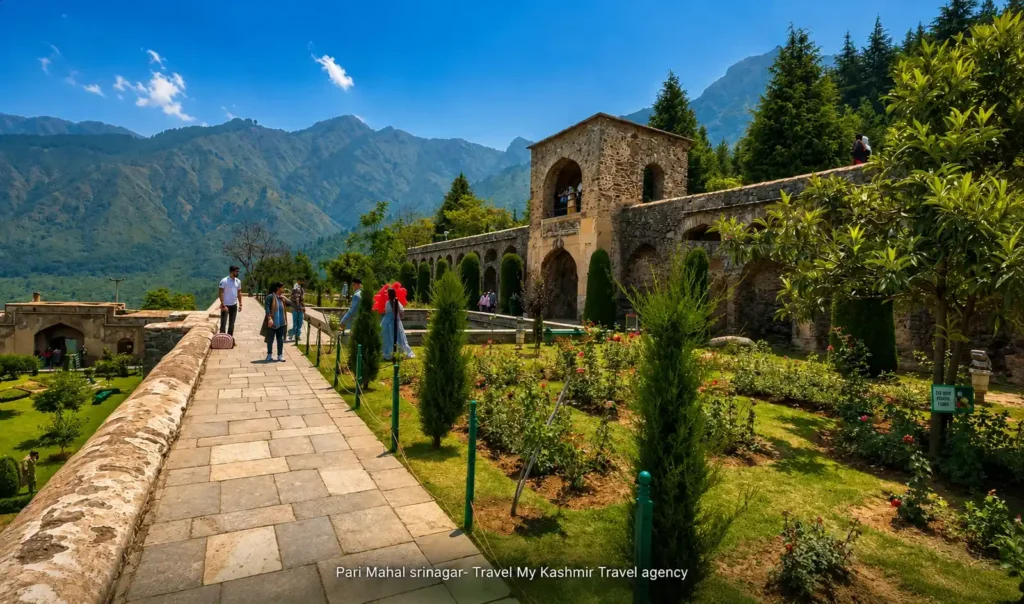
Pari Mahal is also famous as the “Palace of Fairies,” a seven-terraced historic monument above Chashma Shahi. Built in the mid-1600s by Prince Dara Shikoh (eldest son of Shah Jahan), it served as a library, center for astronomical study and school of astrology. Its elevated location makes it one of the better known places in Srinagar for sunset and views over the city.
Pari Mahal offers panoramic views of Dal Lake, Golf Course and the Srinagar city skyline.
- Best Time: 1 to 1.5 hours before sunset.
- Time Needed: 45 minutes to 1 hour.
- Traveler Tip: The road leading up from Cheshma Shahi is steep with sharp curves. Ensure your driver is comfortable with incline driving.
Religious and Historical Attractions
Shankaracharya Temple
Shankaracharya Temple is one of Srinagar’s most important hilltop temples located on Shankaracharya Hill above Dal Lake. This ancient stone temple is dedicated to Lord Shiva. You can climb a long flight of 240 steps to reach the temple. There is also a vehicle road leading up to the temple, with parking a short walk from the top. From here you get wide views over Srinagar, Dal Lake and the surrounding mountains. The climb and temple visit usually require more effort than most city attractions so plan accordingly.
Due to its location inside a protected zone, no electronic items are allowed past the security check. This includes cell phones, smartwatches, cameras, power banks and key fobs. Leave these items safely in your vehicle. Carry a physical ID rather than relying only on a photo or digital copy.
Visit in the morning: The climb is easier before the day heats up and the haze that typically builds over the valley by afternoon can reduce visibility. The temple itself is small and the main highlight for many visitors is the 360-degree view over Srinagar and Dal Lake.
Hazratbal Shrine
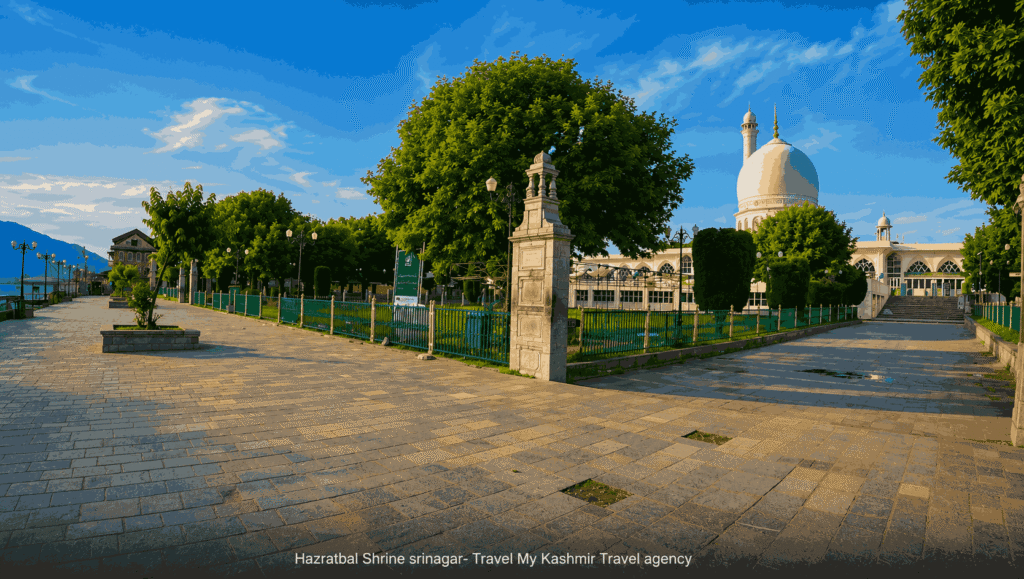
Hazratbal Shrine is a white marble shrine on the northern shore of Dal Lake known for preserving the Moi-e-Muqaddas a relic believed by Muslims to be a hair of Prophet Muhammad. It is one of the most important Muslim religious sites in Kashmir and is especially significant during major religious occasions.
- Location: Hazratbal, roughly 10 km from Dalgate.
- Best Time: Late afternoon. The setting sun lights up the marble facade, and the evening call to prayer (Athan) over the lake is memorable.
- Dress Code: Modest dress strictly required.
Jamia Masjid
Located in Nowhatta, the Jamia Masjid is Srinagar’s primary congregational mosque and an architectural icon of Kashmir. First built by Sultan Sikandar in 1394 AD and expanded by his son Zain-ul-Abidin (“Budshah”). It’s a wooden-pillared mosque (over 370 deodar wood pillars) built in Indo-Saracenic style, and one of the oldest and largest mosques in Kashmir.
Open to all respectful visitors outside of congregational prayer times (avoid visiting during Friday afternoon Juma prayers unless attending).
Makhdoom Sahib Shrine
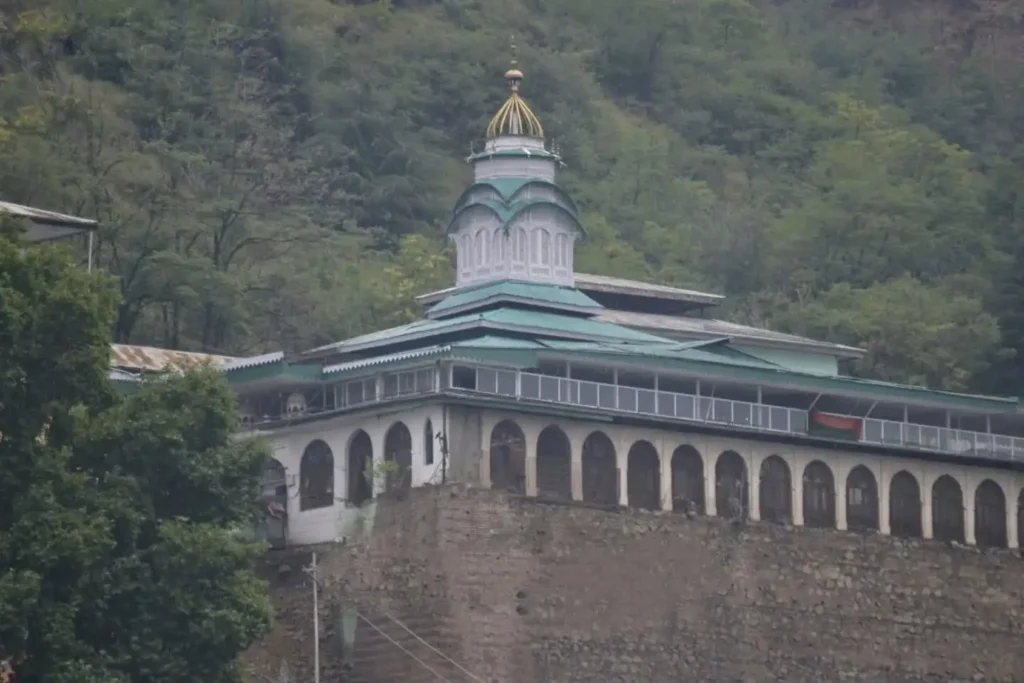
Makhdoom Sahib Shrine is a revered shrine on the southern slope of Hari Parbat Hill. The site can be reached by climbing steps and its elevated position provides views over the Old City and surrounding areas. Check local access conditions before planning a visit.
Get more details about this famous shrine with our Makhdoom Sahib Shrine srinagar guide.
Hari Parbat Fort (Koh-e-Maran)
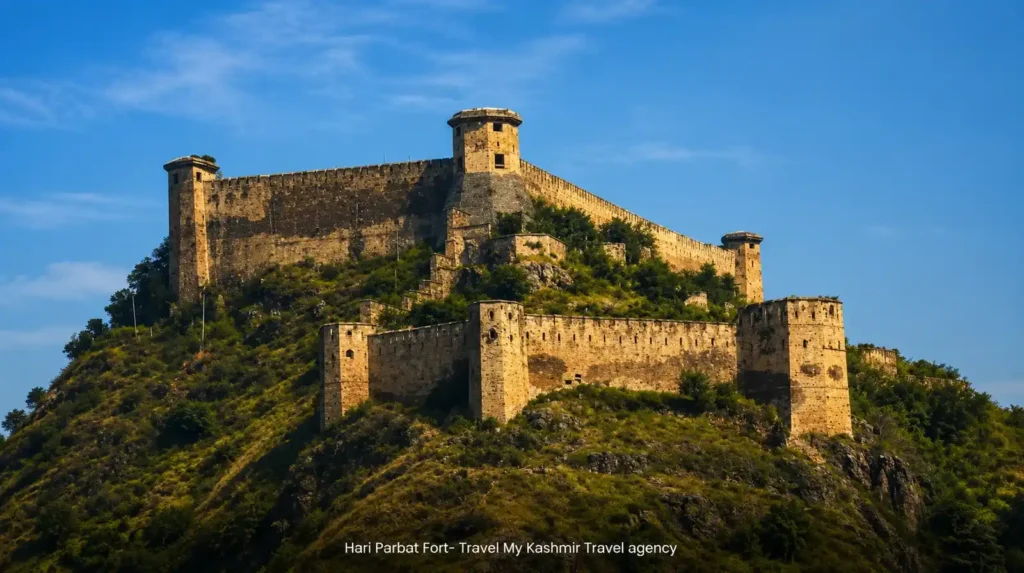
Hari Parbat Fort is a historic fort on top of Hari Parbat Hill built during the Afghan period. The fort sits above several important religious sites, including Makhdoom Sahib Shrine and the Sharika Devi Temple. Visitor access can be restricted, so check the current entry rules before including the fort in your sightseeing plan.
The Hari Parbat holds cultural significance for Muslims, Hindus and Sikhs alike. The fort walls were initially constructed by Mughal Emperor Akbar in 1590 and the current fort structure atop the hill was built in 1808 under Durrani rule.
Other Scenic and Seasonal Spots
Indira Gandhi Memorial Tulip Garden
Indira Gandhi Memorial Tulip Garden is Srinagar’s large seasonal tulip garden overlooking Dal Lake and the Zabarwan hills. It normally opens for a short period in spring usually from late March into April with the exact dates depending on the season and flowering conditions. If your trip falls during the tulip season it is worth adding to your Srinagar sightseeing plan. See our Tulip Garden Srinagar guide.
Outside that flowering season there’s genuinely nothing to see here so don’t build a Srinagar itinerary around it unless your travel dates fall in spring.
Dachigam National Park
Dachigam National Park is about 22 km from central Srinagar this protected area is best known for the Hangul (Kashmir stag) and is also home to leopards, Himalayan black bears and other wildlife. Sightings of larger animals are not guaranteed so visit for the natural views and wildlife experience rather than expecting a safari style encounter.
Dachigam needs advance permission/permit arrangements and is better treated as a half-day trip rather than a quick sightseeing stop. It is a good choice for travelers interested in wildlife, nature and trekking. See our Dachigam permit guide.
Badam Wari
Badam Wari is an old almond garden at the foothills of Hari Parbat, Badam Wari is best known for its pink and white almond blossoms in early spring. It usually blooms around the same time as Srinagar’s tulip season but it is generally quieter than the Tulip Garden. Outside the blossom season the park is a peaceful place for a morning walk or a relaxed visit away from the busier tourist spots.
Zero Bridge
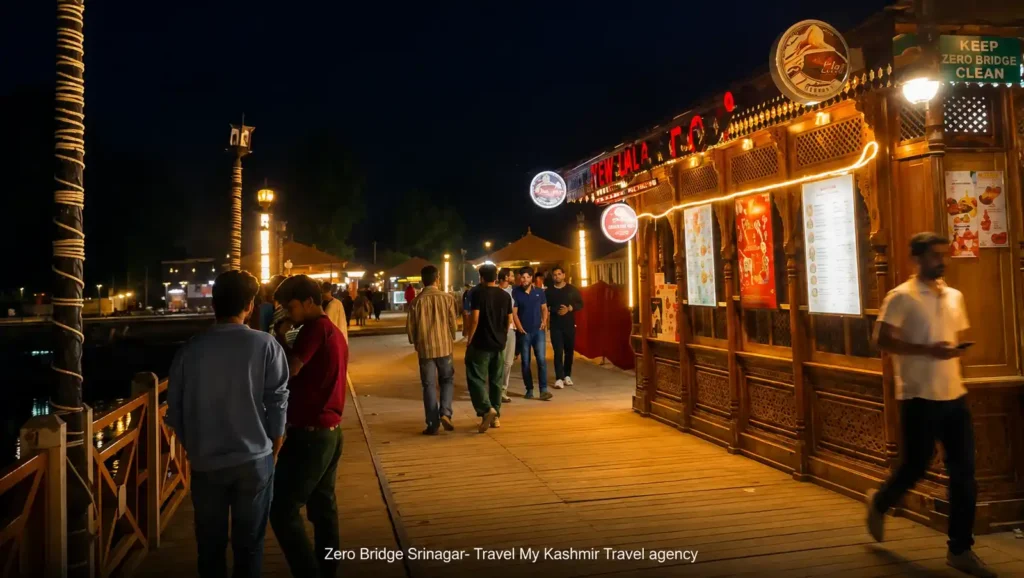
Zero Bridge is a wooden pedestrian bridge over the Jhelum River near Rajbagh, It is more of a local hangout than a traditional monument. It is especially pleasant in the evening when the bridge and surrounding area light up and nearby cafés become lively. It is a good low-effort stop for an evening walk photos and a cup of Kashmiri Kahwa, particularly if you are already sightseeing around Rajbagh or central Srinagar.
Polo View Market & Lal Chowk
Polo View Market is a pedestrian shopping street near Lal Chowk known for Kashmiri handicrafts, local shops, cafés and traditional food. It is a good place to experience the commercial side of Srinagar after visiting the city’s lakes and gardens.
Polo View market is best place for shopping things like Pashmina and Kani shawls, Walnut wood crafts, Papier-mâché products, Kashmiri saffron a and dry fruits and Kashmiri bakery items
Nehru Botanical Garden & Zabarwan Park
Nehru Botanical Garden & Zabarwan Park is located near the foothills of the Zabarwan Range close to Chashma Shahi this green space is a good option for families and travelers looking for a quieter break from sightseeing. The gardens, open spaces and mountain setting make it especially suitable for a relaxed morning or afternoon visit.
Pampore Saffron Fields
Pampore Saffron Fields are about 15 km from Srinagar and are known for the region’s saffron cultivation. The saffron flowering season usually falls in October and early November with the fields taking on purple flowers for a short period. If your trip falls during this season, it can be a worthwhile addition to an autumn Srinagar itinerary or on the way to Pahalgam visit. See our guide to Kashmir in October.
Places to Visit in Srinagar for Different Types of Travelers
Couples: A sunset Shikara ride on Dal Lake, an evening around Nigeen Lake and sunset at Pari Mahal are good choices if you want a slower and more relaxed Srinagar experience. If you prefer quiet places plan the lake and garden visits outside the busiest hours.
Families with kids: The Mughal gardens are easy to include in a family itinerary, with open lawns, fountains and plenty of space to walk around. A shorter Shikara ride on Dal Lake is another easy option. Dachigam National Park can be added if your children enjoy wildlife and nature. The climbs at Hari Parbat and Shankaracharya Temple can be tiring for younger children so consider your children’s age and fitness before including them.
Elderly travelers: Dal Lake is one of the easier sightseeing options because much of the experience can be enjoyed from a Shikara. Chashme Shahi has a relatively compact garden layout while Hazratbal Shrine is also easy to include in a city sightseeing route. Shankaracharya Temple and Hari Parbat involve steep climbs and many steps so travelers with limited mobility may prefer the lakes, gardens and other lower-effort attractions instead.
Photography-focused travelers: Start early at Dal Lake if you want to photograph the floating market and morning activity on the water. Nishat Bagh works well for garden and mountain views while Pari Mahal is a popular choice around sunset. The Tulip Garden adds another strong photography opportunity during its short spring season.
First-time visitors with only one day: Focus on Dal Lake and a Shikara ride followed by the Nishat–Shalimar–Chashme Shahi–Pari Mahal garden circuit. If you start early and have enough time add Shankaracharya Temple. Save places such as Hari Parbat, Dachigam, Nigeen Lake and the Old City for a second day rather than trying to fit everything into one itinerary.
How to Cover Srinagar Sightseeing in 1 or 2 Days
If You Have 1 Day
Start early if you want to see the floating market and fit the main attractions into one day.
Early morning: Start with a Shikara ride on Dal Lake, ideally around sunrise if you want to see the floating market and morning activity on the lake.
Morning: Visit Shankaracharya Temple while the weather is cooler, keeping in mind the climb and security checks.
Late morning to afternoon: Follow the Shalimar Bagh–Nishat Bagh–Chashme Shahi garden route with lunch somewhere along the way.
Late afternoon: Visit Pari Mahal for its elevated views over Srinagar and Dal Lake.
Evening: If you still have time add Hazratbal Shrine if it fits your route or finish with a relaxed evening around Dal Lake or Zero Bridge.
What to skip on a one-day trip: Don’t try to add Hari Parbat, Dachigam, Nigeen Lake and the Old City on top of this route. They take you away from the main sightseeing circuit and can make the day unnecessarily rushed.
If You Have 2 Days
Day 1: Follow the main Dal Lake, Mughal gardens and hilltop viewpoint route above.
Day 2: Explore the Old City, including Jamia Masjid and the surrounding historic streets. Add Hari Parbat if current access and your fitness level allow. Spend the afternoon around Nigeen Lake or visit Hazratbal Shrine. During the spring tulip season, make room for the Indira Gandhi Memorial Tulip Garden.
A common mistake: Trying to fit both Dal Lake and Nigeen Lake Shikara rides into the same itinerary. For most first-time visitors, one good Shikara ride is enough. Use the extra time to explore the gardens, Old City or another part of Srinagar instead.
Places to Visit Near Srinagar
Srinagar is also a convenient base for exploring other parts of the Kashmir Valley. If you have more than two days you can add Gulmarg, Pahalgam, Sonmarg or Doodhpathri as separate day trips rather than trying to combine them with your Srinagar sightseeing.
Gulmarg: roughly 50 km from Srinagar and usually around 1.5–2 hours by road depending on traffic and road conditions. Gulmarg is known for its mountain meadows, Gulmarg Gondola, golf course and winter skiing. In summer the focus is on green meadows and mountain scenery rather than snow.
Pahalgam: roughly 90 km from Srinagar and around 2.5–3 hours by road. The town sits along the Lidder River and serves as a base for places such as Aru Valley, Betaab Valley and Chandanwari. Plan a full day if you want to explore beyond the main town.
Sonmarg: roughly 80 km from Srinagar and around 2.5–3 hours by road depending on conditions. It is known for the Sindh River, mountain scenery and access to Thajiwas Glacier. The area is also on the route towards Ladakh via Zoji La.
Doodhpathri: around 40–45 km from Srinagar, Doodhpathri is a quieter meadow destination known for green hills, open landscapes and the Shaliganga stream. It is a good option if you want a less crowded day trip and don’t want to travel as far as Gulmarg or Pahalgam.
Planning tip: Don’t try to combine Gulmarg, Pahalgam or Sonmarg with a full day of Srinagar sightseeing. Each deserves its own day if you want to enjoy the destination rather than spend most of the day on the road
Frequently Asked Questions
What are the best places to visit in Srinagar?
The best places to visit in Srinagar include Dal Lake, the Mughal garden cluster (Nishat Bagh, Shalimar Bagh, Chashme Shahi), Pari Mahal and Shankaracharya Temple form the core of most itineraries. If you have extra time, Hari Parbat, Nigeen Lake and the old city around Jamia Masjid round it out well.
How many days are enough for Srinagar sightseeing?
Two days covers the city comfortably without rushing. One day is workable if you start early and accept skipping Hari Parbat, Dachigam and Nigeen Lake.
Can I cover Srinagar sightseeing in one day?
Yes, you can cover the main highlights in one day by following a focused route by starting early at Shankaracharya Temple, visit Pari Mahal and Nishat Bagh in the afternoon and finish with a sunset Shikara ride on Dal Lake.
What is the best time for Srinagar sightseeing?
March to October is the most popular period. Spring (March–April) offers tulip blooms and almond blossoms; summer (May–August) brings pleasant, cool weather ideal for escape from city heat; and autumn (September–November) features golden Chinar foliage. Winter (December–February) is best if you want to experience snow landscapes.
What are the best places to visit in Srinagar in winter?
During winter (December to February) top spots include snow covered Boulevard Road along Dal Lake, Pari Mahal for panoramic views of snow-dusted roofs, winter walks at Polo View Market and cozying up in a heated houseboat equipped with a traditional Bukhari (wood stove).
Which places can I visit near Srinagar?
Gulmarg, Pahalgam and Sonmarg are the three most common add-ons each roughly 1.5–3 hours away by road and each deserving its own full day rather than being combined with Srinagar city sightseeing.
Which places are best for couples in Srinagar?
Pari Mahal at sunset, a private evening Shikara ride on Dal Lake, a quiet stay on a Nigeen Lake houseboat and walks through Nishat Bagh or Badam Wari (in spring) offer some of the most scenic and peaceful settings for couples.
Which places are best for families and elderly travelers?
The Mughal gardens are the easiest for kids with open lawns, fountains and short walking distances. A shorter Shikara ride works well too. For elderly travelers, Nishat Bagh and Cheshma Shahi offer gentle walking paths. Note that Shankaracharya Temple requires climbing 240 stone steps, so plan accordingly.
Which Srinagar attractions are worth visiting in the evening?
The Jhelum Riverfront at Zero Bridge, Polo View Market, Boulevard Road along Dal Lake and Pari Mahal (for sunset) are excellent evening options.